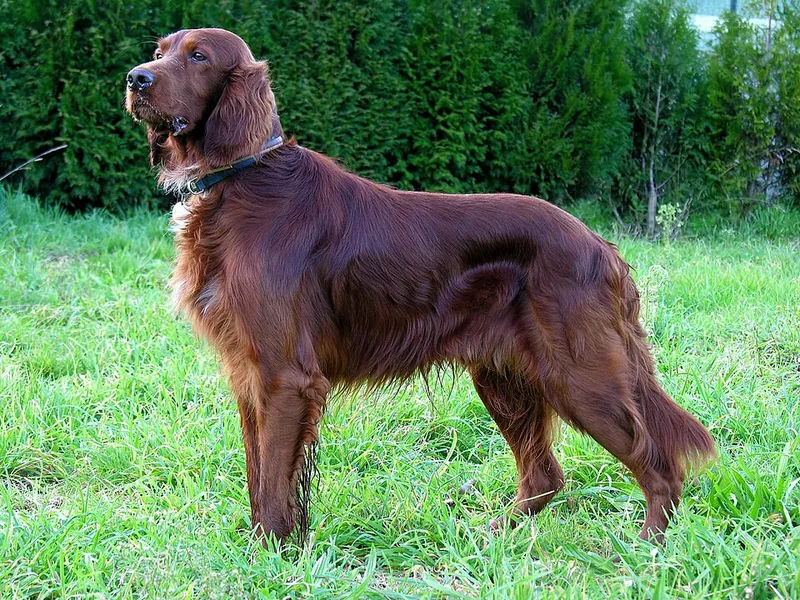
Irish SetterExuberant red gundog from Ireland
The Irish Setter is a tall, glamorous gundog with a rich mahogany coat and a famously happy-go-lucky temperament. It is friendly with everyone and wonderful with children, but it needs lots of exercise and matures slowly, so it suits active households.
Why people love the Irish Setter
- Friendly with people, children and other dogs
- Joyful, playful nature that lasts for years
- Stunning mahogany coat with a silky finish
- Great companion for running, hiking and field sports
- Rarely shows guarding or territorial behavior
Things to consider
- Needs one to two hours of exercise every day
- Slow to mature and easily distracted
- Dislikes being alone for long periods
- Feathered coat collects burrs and needs regular brushing
- Bloat risk as a deep-chested breed
Is this breed right for you?
10 questions · live resultHistory and Origin
The Irish Setter was developed in Ireland in the 1700s to find game birds and set, or point, them for hunters with nets and later guns. Early setters were often red and white; the solid red dogs became especially prized in the 1800s.
Show popularity in the late 1800s and 1900s favored glamour, and the breed later split somewhat into show and field lines. The AKC recognized the breed in 1878 and places it in the Sporting group. The Kennel Club lists it as a Gundog under the name Irish Setter.
The closely related Irish Red and White Setter is recognized as a separate breed, and represents the older color pattern from which the solid red dogs were selected.
Size, Coat and Color
The Irish Setter is a tall, elegant sporting dog with a racy outline. Adults stand about 22 to 26 inches at the shoulder and weigh roughly 60 to 71 lb. Males sit at the upper end of both ranges and carry more coat and a broader head, while females are lighter and more feminine in expression.
The breed comes in one color only: mahogany or rich chestnut red, with no black. A small amount of white on the chest, throat or toes, or a narrow streak on the head, is accepted.
The coat is short and fine on the head and front of the legs, and moderately long and flat elsewhere. Feathering grows on the ears, the backs of the legs, the belly, chest and tail. Field-bred dogs are often smaller and lighter, with shorter feathering and a slightly paler red, while show lines carry a fuller coat and a more upright posture. The full adult coat and feathering take around two years to develop.
Temperament and Personality
Irish Setters are outgoing, sweet-natured and playful. They are typically friendly with strangers, good with other dogs and patient with children, which makes them poor guard dogs but appealing family companions.
They mature slowly and keep a puppyish exuberance for several years. They are sensitive and people-focused and often dislike being alone. Their hunting instincts mean birds and small animals attract their attention, and they can range widely.
Many owners describe the breed as a perpetual teenager: affectionate, funny and occasionally scatterbrained. Patience through the first three years pays off, as most settle into gentle, steady adults.
Are Irish Setters Good for First-Time Owners?
Yes, for active first-time owners who have time to train and exercise them. Irish Setters are friendly, forgiving and rarely show guarding behavior, so they are easier to socialize than many large breeds.
The challenge is energy and attention span. Setters stay puppyish for two to three years, pull on the leash, jump on visitors and may run off after birds. First-time owners should plan for group classes, long daily outings and recall training on a long line. People who want a calm, quick-to-obey dog may find the setter's exuberance tiring, but those who enjoy the outdoors usually love it.
Can Irish Setters Live in an Apartment?
It is not ideal, but an adult Irish Setter can manage in a spacious apartment if its owner provides one to two hours of exercise every day, including off-leash running in safe, fenced areas.
The difficulty is mostly the young dog. Adolescent setters are bouncy and restless indoors and may become destructive without enough outlets. Easy access to parks or open land matters more than square footage. A house with a securely fenced yard is easier, but even then the yard does not replace daily runs and walks with the owner.
Can Irish Setters Be Left Alone?
Only for moderate periods. Irish Setters are people-focused dogs and many become anxious, noisy or destructive when left alone for a full workday.
A well-exercised adult can usually cope with a few hours alone if it has been taught gradually from puppyhood. Start with short absences, use a crate or safe room and give a chew or food puzzle when you leave. For longer days, a dog walker, doggy daycare or a second dog helps. Expect slower progress with adolescents, which have more energy and less self-control than mature setters.
Exercise and Training
Irish Setters are built for endurance and need at least one to two hours of exercise daily, including free running in secure areas. Field work, hiking, canicross and agility suit them well.
- Train with gentle, reward-based methods; they are eager but sensitive.
- Work on recall from puppyhood, as they may follow a scent far.
- Keep sessions short and fun to hold their attention.
- Teach calm manners early; adolescent setters can be very bouncy.
Grooming and Shedding
The silky coat is moderately long with feathering on the ears, chest, legs and tail. Brush two or three times a week to prevent tangles and remove debris after outdoor runs. Trim hair between the pads and around the ears to keep them neat.
Shedding is moderate. Check the long ears regularly, as poor airflow can lead to infections.
Field-bred Irish Setters often have shorter, lighter feathering and a slightly smaller frame, while show dogs carry a longer, fuller coat that needs more brushing.
Feeding and Nutrition
Irish Setters are lean athletes, and they should look it. Aim for a body where the ribs are easy to feel and a clear waist is visible from above. Field dogs in hunting season can need considerably more food than house companions, so adjust through the year.
As a deep-chested breed, the Irish Setter has a documented risk of bloat (gastric dilatation-volvulus). Reduce risk by:
- Feeding two or three smaller meals instead of one large one.
- Avoiding vigorous exercise for an hour before and after meals.
- Using slow-feeder bowls if the dog gulps.
- Keeping feeding calm, away from competition with other dogs.
Puppies grow fast; use a diet suited to large-breed growth and avoid overfeeding, which stresses developing joints. Some Irish Setters have sensitive digestion, and gluten-sensitive enteropathy has been documented in the breed, so discuss chronic loose stools or weight loss with your vet rather than switching foods repeatedly. Hypothyroidism can cause weight gain despite normal portions.
| Adult weight | Less active | Typical adult | Very active |
|---|---|---|---|
| 60 lb | 1,170 kcal | 1,330 kcal | 1,670 kcal |
| 71 lb | 1,320 kcal | 1,510 kcal | 1,890 kcal |
Estimates use the resting energy formula veterinarians work with (70 × body weight in kg0.75) and standard activity factors. Use the feeding guide on your food as a starting point and adjust to body condition. Puppies, seniors, pregnant animals and pets that need to lose weight have different needs, so ask your vet.
Health and Lifespan
Irish Setters typically live 12 to 15 years. Health issues include hip dysplasia, progressive retinal atrophy and hypothyroidism. As a deep-chested breed, they are at risk of bloat, so feed several smaller meals and avoid vigorous exercise right after eating.
DNA tests exist for rcd1 PRA and canine leukocyte adhesion deficiency (CLAD), both known in the breed. Ask breeders for these results and hip scores.
Irish Setter Price and Cost of Ownership
Typical breeder price in the US$1,500 to $2,500
An Irish Setter puppy from a reputable US breeder typically costs about $1,500 to $2,500. Prices vary by breeder, region and lines, and field-line and show-line puppies may be priced differently. Ask for hip scores and DNA results for rcd1 PRA and CLAD in both parents.
Irish Setter rescue groups and shelters occasionally place adult dogs, which can be a good option for people who prefer to skip the long puppy stage.
Breed-specific ongoing costs include:
- Grooming supplies and occasional trims for the feathered coat.
- Insurance that covers bloat surgery, a costly emergency in deep-chested dogs.
- Training classes through a long adolescence.
- Dog walkers or daycare if you work away from home.
Is the Irish Setter Right for You?
An Irish Setter suits active families who spend lots of time outdoors, enjoy a sociable, affectionate dog and have space with a secure yard.
It is less suited to apartments, owners away all day, or people seeking a calm, low-energy companion.
A securely fenced yard and access to open land for running make life with an Irish Setter much easier.
Irish Setter Traits at a Glance
Irish Setter FAQ
Are Irish Setters good family dogs?
Yes. They are friendly, playful and good with children, though their size and energy can overwhelm toddlers.
How big do Irish Setters get?
Irish Setters stand about 22 to 26 inches tall and weigh roughly 60 to 71 lb.
How much exercise does an Irish Setter need?
At least one to two hours daily, including off-leash running in safe areas.
Do Irish Setters shed?
Moderately. Their feathered coat needs brushing a few times a week.
Are Irish Setters hard to train?
They are eager and friendly but easily distracted and slow to mature, so patience and consistency matter.
How long do Irish Setters live?
Most live 12 to 15 years.