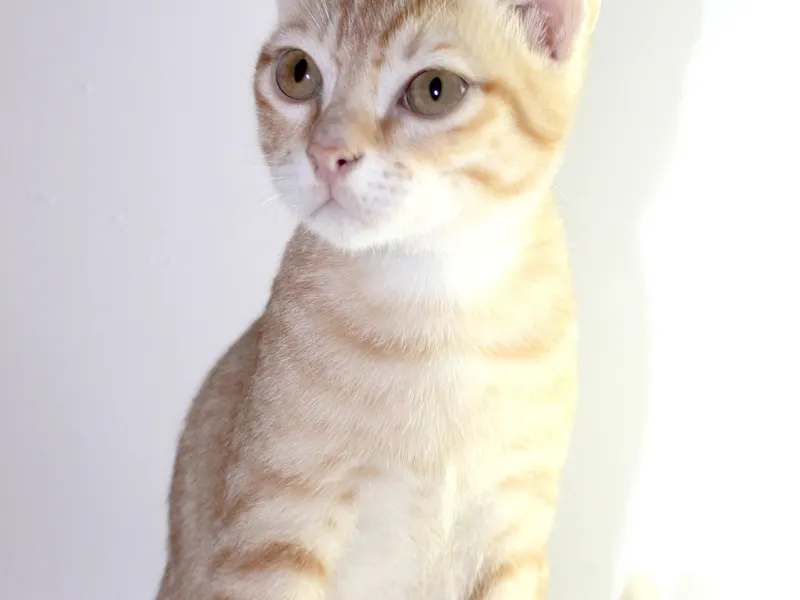
SavannahA tall, spotted serval hybrid with energy
<p>The Savannah is a tall, long-legged spotted cat created by crossing domestic cats with the African serval. It is athletic, bold and highly intelligent, and early generations can be a real handful. It suits experienced owners with time, space and patience, and only where local law allows it.</p>
Why people love the Savannah
- Dog-like cat that learns tricks and walks on a harness
- Striking tall, spotted, wild look
- Highly intelligent and endlessly curious
- Short coat with light to moderate shedding
- Bonds closely with its people
Things to consider
- Extremely active; needs daily vigorous play and cat-proofing
- Legal restrictions on some generations in some states
- Early generations are costly and demanding
- Can open doors, cabinets and reach any shelf
- Less long-term health data than older breeds
Hybrid: early generations (F1-F4) are banned or restricted in some US states and cities (for example Hawaii) and in some countries, and Australia does not allow import; later SBT generations are treated as domestic cats in most places. Check state, local and landlord rules before buying.
Is this breed right for you?
10 questions · live resultHistory and Origin
The first known Savannah kitten was born in 1986 in Pennsylvania, from a cross between a male serval owned by breeder Judee Frank and a domestic Siamese female. The kitten was named Savannah, and the name later passed to the breed. In the late 1980s and 1990s, breeders including Patrick Kelley and Joyce Sroufe worked to develop the cats into a breed and wrote an early standard.
TICA began registering Savannahs in 2001 and granted the breed championship status in 2012. Only later-generation cats, several steps removed from the serval, can be shown. Savannahs are described by generation:
- F1: one serval parent, roughly half serval.
- F2 and F3: serval grandparent or great-grandparent.
- F4 and later, SBT: "stud book tradition" cats, at least four generations of Savannah-to-Savannah breeding.
Early-generation males are usually infertile, so males used for breeding are typically from later generations.
Size, Generations, Coat and Colors
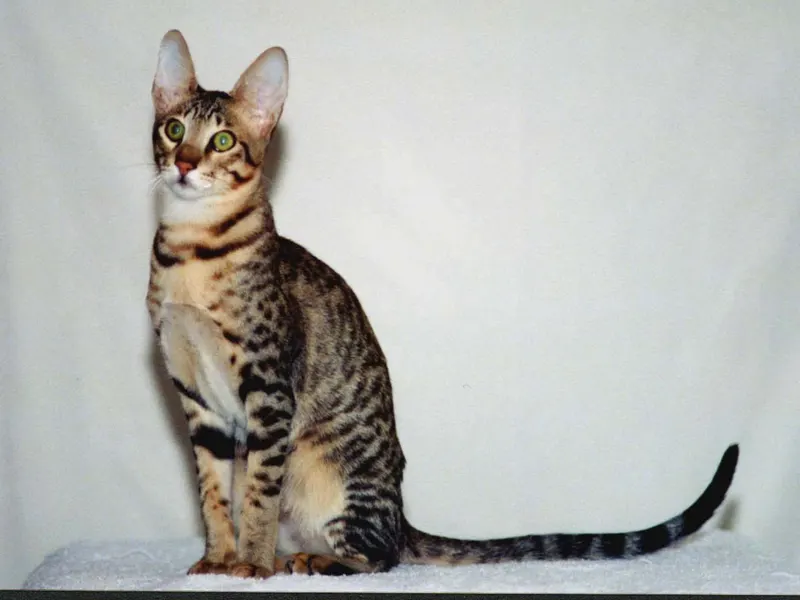
The Savannah is a tall, long-legged, lean cat with a long neck, large upright ears and a short, thick tail, all inherited from the serval. Adults weigh about 12 to 25 lb, but their height and long legs make them look larger than their weight suggests.
Generation strongly affects size and look:
- F1 and F2 cats are usually the tallest and most serval-like, with males at the top of the weight range.
- F4 to SBT cats are typically smaller, though still larger and leggier than most domestic cats.
Males are generally larger and heavier than females in every generation.
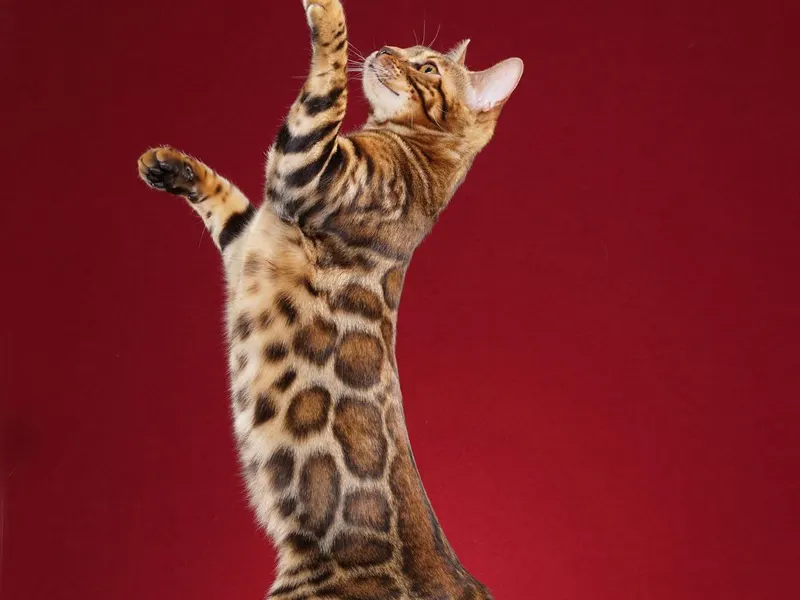
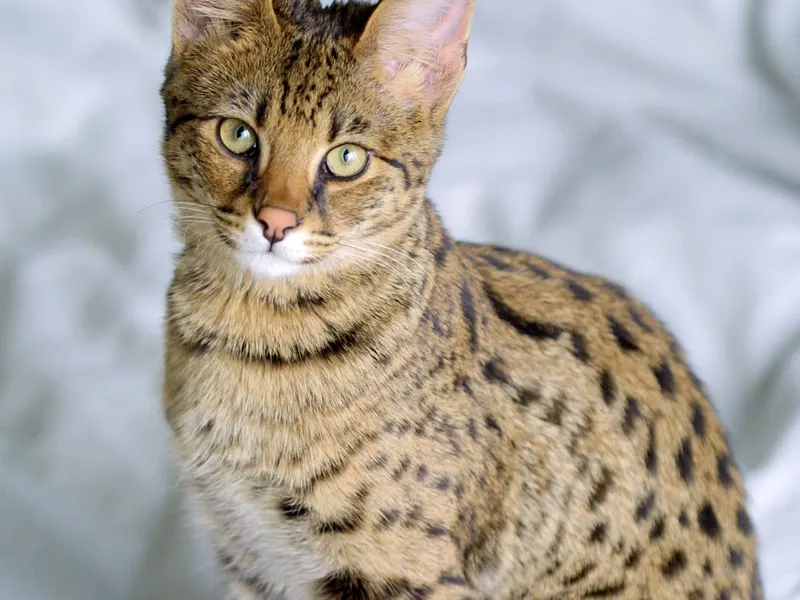
The coat is short to medium in length, coarse to the touch, with bold, solid dark spots. TICA accepts four colors:
- Brown spotted tabby
- Silver spotted tabby
- Black
- Black smoke
Black and black smoke Savannahs often show ghost spotting in certain light. The eyes are hooded with distinctive tear-stain markings running from the inner corners down the face, and the ears often have ocelli, white spots on the backs.
Personality and Temperament
Savannahs are confident, curious and bonded to their people. Many follow owners around, learn to walk on a harness, play fetch and greet familiar people with head-butts. Some chirp like a serval, and some hiss or make a serval-like snort when startled, which is not necessarily aggression.
Generation matters. F1 and F2 cats tend to be larger, more intense and more wary of strangers, and they need very experienced owners. F4 and SBT cats are usually closer to an active domestic cat in temperament. With all generations, early socialization makes a big difference in how they handle visitors, children and other pets.
Are Savannah Cats Good with Kids?
Later-generation Savannahs often do well with children who are calm and respectful. Many enjoy interactive games and can be patient playmates.
Some points to keep in mind:
- Early generations can be more intense, unpredictable and sensitive to handling, so they are less suited to homes with young children.
- Savannahs are strong, fast jumpers and may accidentally knock over small children while playing.
- Children should learn to let the cat approach and to avoid chasing it.
Supervise interactions with toddlers, and choose an F4 or SBT cat from a breeder who raises kittens around children.
Should Savannah Cats Be Kept Indoors Only?
Yes, most breeders and many vets recommend keeping Savannahs indoors, with safe outdoor access through a secure enclosure or harness walks. These cats are bold explorers and can roam far, which increases the risk of traffic accidents, theft and conflicts with wildlife or neighbors.
Their wild look can also cause problems if a Savannah is reported as an escaped wild animal. In some places, regulations also require secure housing for early generations.
Indoor life works well if you provide climbing structures, daily vigorous play, puzzle feeders and training. A catio or enclosed garden space gives safe outdoor enrichment.
Can Savannah Cats Be Left Alone?
For a normal workday, many later-generation Savannahs cope if their needs are met before and after. They are not ideal for owners who are away long hours every day without enrichment.
A bored Savannah alone at home often finds its own entertainment: opening cabinets, knocking items off shelves or playing in water. To help:
- Hold a vigorous play session before you leave.
- Leave puzzle feeders and rotate toys.
- Cat-proof cabinets and secure breakables.
- Consider a second active cat for company.
Early generations tend to need more attention and are less suited to long absences.
Activity, Play and Enrichment
This is one of the most active cats you can own. Savannahs can leap onto top shelves and refrigerators from the floor, open doors and cabinets, and get into anything not secured.
- Provide tall, heavy cat trees anchored to the wall, plus wall shelves.
- Plan for at least two vigorous play sessions a day with wand and chase toys.
- Clicker training, harness walks and secure outdoor enclosures burn mental and physical energy.
- Many enjoy water; secure toilets and aquariums.
Without this outlet, boredom often turns into destructive behavior.
Grooming and Shedding
The short, coarse spotted coat is easy to care for. A weekly brush with a rubber mitt removes loose hair, and shedding is light to moderate. Nail trims every couple of weeks and regular tooth brushing matter more than coat care. Standard colors are brown spotted tabby, black, black smoke and silver spotted tabby.
Feeding and Nutrition
Savannahs are lean, muscular and very active, and their nutrition should support that build without adding excess weight. Feed a complete and balanced diet suited to their life stage, and judge portions by body condition: you should feel ribs easily, with a defined waist.
Savannahs grow and mature slowly, often reaching full size around two to three years, especially in early generations. Kittens and young cats need a complete growth diet throughout this period, guided by your vet.
- Many Savannahs do well with several small meals a day, matching their active nature.
- Puzzle feeders and food-dispensing toys turn meals into enrichment and reduce boredom.
- Use part of the daily ration for clicker training, which Savannahs enjoy.
- Encourage hydration with fountains or wet food, as many Savannahs like moving water.
Raw diets are popular with some owners, but they must be carefully formulated to be complete and handled safely. Discuss any home-prepared or raw diet with your vet. Watch for chewing on non-food items, as foreign-body ingestion is a known risk in this curious breed.
| Adult weight | Indoor, less active | Typical adult | Active or intact |
|---|---|---|---|
| 12 lb | 250 kcal | 300 kcal | 350 kcal |
| 18 lb | 340 kcal | 410 kcal | 470 kcal |
| 25 lb | 430 kcal | 520 kcal | 610 kcal |
Estimates use the resting energy formula veterinarians work with (70 × body weight in kg0.75) and standard activity factors. Use the feeding guide on your food as a starting point and adjust to body condition. Kittens, seniors, pregnant animals and pets that need to lose weight have different needs, so ask your vet.
Health and Lifespan
Savannahs commonly live 12 to 20 years. As a relatively young hybrid breed, they have less long-term health data than older breeds. Points to know:
- Early-generation males are usually sterile, a known effect of the species cross.
- Hypertrophic cardiomyopathy (HCM) has been reported; ask about echocardiogram screening of breeding cats.
- Some early-generation cats react differently to certain anesthetics and vaccines; tell your vet the generation.
- Their curiosity makes foreign-body ingestion (chewed toys, hair ties) a real risk.
Feed a complete, balanced commercial or vet-formulated diet; raw diets are popular among owners but need careful formulation.
Savannah Price and Cost of Ownership
Typical breeder price in the US$1,500 to $20,000
Savannah prices in the US vary more than almost any other breed. Later-generation (SBT) pet kittens from reputable breeders often start around $1,500, while F1 kittens can reach $15,000 to $20,000. Prices vary by breeder, region, lines and generation.
Savannahs occasionally appear in rescues, often when owners underestimated their energy, so adoption is worth checking.
Breed-specific ongoing costs include:
- Permits or registrations where required for certain generations; check state and local law before buying
- Tall, heavy cat trees, wall shelves and a secure outdoor enclosure
- Echocardiogram screening if you breed or if your vet recommends it
- Insurance that covers foreign-body surgery; confirm that hybrid breeds are accepted
- Replacing items damaged by a curious, athletic cat
Is the Savannah Right for You?
A later-generation Savannah can be a rewarding companion for an active household that wants a dog-like, trainable cat and has time to provide daily exercise. Early generations are a specialist commitment and not suited to most homes.
Before buying, check the law. Some US states and cities restrict or ban early generations, Hawaii bans them, and some countries such as Australia do not allow import. Landlords and insurers may also have rules. Prices vary hugely by generation, breeder and region: SBT pet kittens often start around $1,500 to $5,000, while F1 kittens can reach $15,000 to $20,000.
Savannah Traits at a Glance
Savannah FAQ
Are Savannah cats legal?
It depends on where you live and the generation. Some US states and cities restrict or ban early generations (F1 to F4), Hawaii bans them, and some countries prohibit import, so check state, local and rental rules first.
How big do Savannah cats get?
Most adults weigh 12 to 25 lb (about 5 to 11 kg), and F1 and F2 males are the tallest and heaviest. Their long legs make them look bigger than their weight suggests.
What does F1, F2 or SBT mean?
It shows how many generations a cat is from the serval. F1 has a serval parent, F2 a serval grandparent, and SBT cats have at least four generations of Savannah-to-Savannah breeding.
How much does a Savannah cat cost?
Later-generation (SBT) pet kittens commonly cost about $1,500 to $5,000, while F1 kittens may cost $15,000 or more. Prices vary by breeder and region.
Are Savannah cats good with dogs?
Many later-generation Savannahs get on well with confident, cat-friendly dogs, especially when raised together. Early generations can be more unpredictable.
Are Savannah cats good pets?
Later generations can be loyal, trainable and entertaining pets for active, experienced owners. They need far more exercise, enrichment and cat-proofing than an average house cat.