Manchester TerrierSleek black-and-tan English ratter
The Manchester Terrier is a sleek, black-and-tan terrier bred in industrial England to hunt rats and rabbits. Alert, clever and affectionate, it is easy to groom but has a strong prey drive and an independent streak.
Why people love the Manchester Terrier
- Sleek coat needs almost no grooming
- Long-lived, often 15 to 17 years
- Clever and quick to learn with positive training
- Affectionate and keen to be with its family
- Alert watchdog without excessive size
Things to consider
- Strong prey drive puts small pets at risk
- Can be stubborn and sensitive to harsh handling
- Prone to escaping through fence gaps
- Needs daily exercise and mental challenges
- Reserved with strangers if poorly socialized
Is this breed right for you?
10 questions · live resultHistory and Origin
The breed was developed in the mid-19th century in Manchester, England, where John Hulme is credited with crossing whippets and black-and-tan terriers to create a fast, agile dog for rat-killing and rabbit coursing.
Toy and Standard varieties exist. The AKC places the Standard in the Terrier Group and the Toy in the Toy Group, while The Kennel Club lists the Manchester Terrier in the Terrier Group and the English Toy Terrier separately.
Rat-killing was a popular sport in Victorian England, and the breed excelled in rat pits. After the sport was banned, the Manchester became a household companion. Its numbers declined during the World Wars, but breeders in Britain and North America maintained the line.
Size, Varieties and Markings
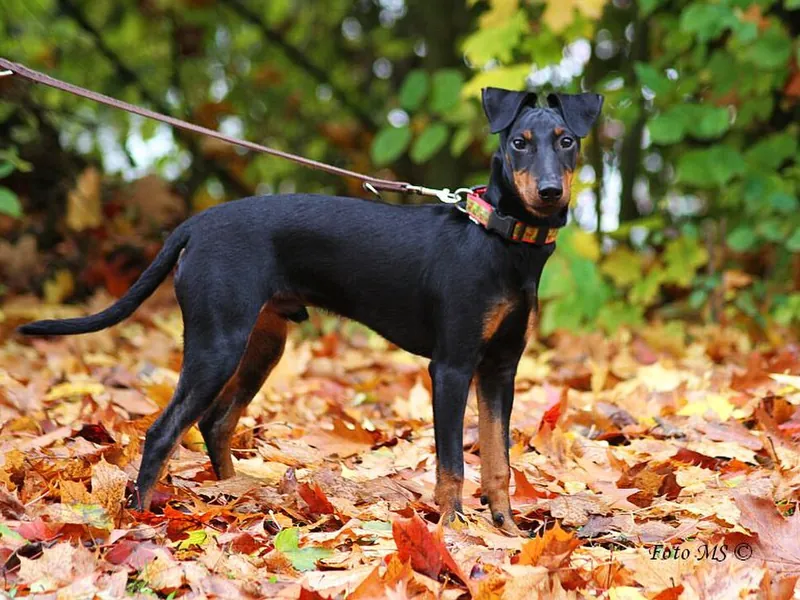
The Manchester Terrier is a sleek, compact terrier with a long, wedge-shaped head, small dark eyes and a slightly arched back. The Standard variety stands about 15 to 16 inches tall and weighs roughly 11 to 22 lb. In the US, the AKC also recognizes a Toy variety under 12 lb, shown in the Toy Group. Males and females look similar, with males slightly heavier.
The coat is short, smooth and glossy, always jet black and rich mahogany tan with clear, sharply defined markings:
- Tan spots above each eye and on each cheek
- Tan on the muzzle, throat and lower legs
- A black thumbprint on the front of each foreleg
- Black pencil lines on the top of the toes
White markings are a serious fault. Ears can be naturally erect, button or, in the Standard variety in the US, cropped. Cropping is banned in the UK and much of Europe, so British Manchesters always have natural ears.
Temperament and Personality
Manchesters are lively, alert and affectionate with their family. They can be reserved with strangers and make good watchdogs.
Prey drive is strong, so small pets are at risk. They are sensitive and can be stubborn, responding best to positive training.
Manchesters tend to be keen observers and enjoy following their owners around the house. They are less scrappy with other dogs than some terriers but still have a strong will. Many enjoy snuggling under blankets after a walk.
The breed is sensitive and responds well to gentle guidance and positive reinforcement. Manchesters are good watchdogs and alert their owners to unusual sounds or visitors.
Do Manchester Terriers Bark a Lot?
Manchester Terriers are alert and will bark at unusual sounds or visitors, but they are generally not nonstop barkers.
They make effective watchdogs because they notice everything. Barking becomes a problem mainly when a Manchester is bored, under-exercised or left alone for long periods. Daily exercise, puzzle toys and training games reduce excess barking. Teaching a quiet cue early and rewarding calm behavior at the door helps them understand when to stop. In apartments, early training is particularly important.
A Manchester that has learned the quiet cue usually gives a short alert and then settles, which is what most owners want.
Are Manchester Terriers Good Apartment Dogs?
Yes, Manchester Terriers can adapt well to apartment life if they get enough daily exercise and mental work.
Their small size and easy grooming make them practical indoors. Plan on at least 45 minutes to an hour of activity each day, including brisk walks and chase games. Without it, they may become restless or vocal. Their curious nature means they explore everything, so keep small items and cables out of reach. Many Manchesters enjoy snuggling under blankets after exercise, which suits apartment living.
Are Manchester Terriers Good with Cats?
Some Manchester Terriers live peacefully with cats they grow up with, but their strong prey drive means caution is always needed.
Bred to catch rats, many Manchesters instinctively chase small, fast-moving animals. A puppy raised with a confident cat often learns to coexist, but adult Manchesters may still chase unfamiliar cats outdoors. Introductions should be slow, with the cat given high escape routes. Small pets such as rodents, rabbits and birds are rarely safe with this breed and should be kept separate.
Exercise and Training
They need daily exercise and mental challenges. Agility, earthdog and lure coursing are good outlets.
- Keep on leash outside secure areas.
- Use rewards and short sessions.
- Provide puzzles and toys.
Plan on at least 45 minutes to an hour of activity daily. Manchesters love chasing toys, sprinting and exploring. They can be escape artists, so check fences for gaps.
Because they are sight-oriented as well as scent-oriented, Manchesters may bolt after moving objects. Practice recall in enclosed areas and use a leash in open spaces.
Grooming and Shedding
The short, glossy coat needs minimal care: weekly brushing with a soft brush or mitt. Shedding is light.
The coat is always black and tan, with clearly defined markings. A quick wipe with a damp cloth keeps it glossy. Trim nails regularly and brush teeth to prevent dental disease.
Feeding and Nutrition
Manchester Terriers are naturally lean and athletic, and keeping them that way supports their long lifespan. A fit Manchester shows a clear waist and ribs you can feel easily. Because their coat is short and close, weight gain is easy to see.
Feed a complete diet suited to the dog's age, size and activity level. Toy-variety puppies are small enough to be at risk of low blood sugar, so feed young puppies three or four small meals a day. Adults usually do well on two meals.
- Count training treats toward the daily ration; Manchesters are food-motivated and learn quickly with tiny rewards.
- Dental care matters in small terriers. Daily brushing helps prevent tartar and gum disease.
- Food puzzles and scatter feeding satisfy their urge to hunt and help prevent boredom.
- Adjust portions as activity drops with age; seniors often need less food.
| Adult weight | Less active | Typical adult | Very active |
|---|---|---|---|
| 11 lb | 330 kcal | 370 kcal | 470 kcal |
| 16 lb | 430 kcal | 500 kcal | 620 kcal |
| 22 lb | 550 kcal | 630 kcal | 790 kcal |
Estimates use the resting energy formula veterinarians work with (70 × body weight in kg0.75) and standard activity factors. Use the feeding guide on your food as a starting point and adjust to body condition. Puppies, seniors, pregnant animals and pets that need to lose weight have different needs, so ask your vet.
Health and Lifespan
Manchesters often live 15 to 17 years. Von Willebrand disease, juvenile cardiomyopathy and Legg-Calve-Perthes disease are reported. DNA tests exist for some conditions.
Ask breeders for von Willebrand disease and juvenile cardiomyopathy DNA results and eye exams. With good care, Manchesters are among the longest-lived terrier breeds.
Manchester Terrier Price and Cost of Ownership
Typical breeder price in the US$1,000 to $2,500
A Manchester Terrier puppy from a reputable US breeder typically costs about $1,000 to $2,500. Prices vary by breeder, region, variety and lines. The breed is not common, so waiting lists are likely. Responsible breeders test for von Willebrand disease and screen eyes and hips.
Breed rescues occasionally place adult Manchesters, often well suited to experienced terrier homes.
Breed-specific ongoing costs include:
- Secure fencing or gap repairs, as Manchesters can slip through small openings.
- Pet insurance for bleeding disorders, eye problems and injuries.
- Dental cleanings, common in small breeds.
- Coats for cold weather due to the short coat.
Food and grooming costs remain low.
Is the Manchester Terrier Right for You?
At 11 to 22 lb and 15 to 16 inches, the Manchester suits active owners and apartment dwellers who can provide exercise. It is not ideal with small pets.
Manchesters suit owners who enjoy a lively, intelligent dog and can provide structure. They are good for first-time owners willing to invest in training. They are less suited to households with cats or small animals.
With a lifespan that can reach the mid to late teens, a Manchester is a long commitment. Plan for its needs in later years, including dental care and keeping it warm in cold weather, since the thin coat offers little insulation.
Manchester Terrier Traits at a Glance
Manchester Terrier FAQ
Are Manchester Terriers good family dogs?
Yes, with older children and active owners.
Do Manchester Terriers shed?
They shed lightly.
How long do Manchester Terriers live?
Often 15 to 17 years.
How big do Manchester Terriers get?
The Standard Manchester stands about 15 to 16 inches and weighs roughly 11 to 22 lb.
Are Manchester Terriers easy to train?
They are intelligent but can be stubborn. Positive, consistent training works best.
What is the difference between a Manchester Terrier and a Doberman?
They look similar in color, but the Manchester is a small terrier, while the Doberman is a much larger working breed.