Bull-BoxerA playful Boxer and Bulldog mix
The Bull-Boxer is a crossbreed most often produced from a Boxer and an English Bulldog, with a muscular build and a cheerful, clownish personality. Affectionate and family-oriented, it needs owners who plan for its exercise, its stubborn streak and the health risks that come with short muzzles.
Why people love the Bull-Boxer
- Playful, affectionate and family-oriented
- Short coat needs only a weekly brush
- Usually loves children and active games
- Often combines Boxer energy with Bulldog calm
- Medium-large size without giant-breed costs
Things to consider
- Shorter muzzles bring breathing problems and heat intolerance
- Size, look and temperament vary widely
- Can be stubborn during training
- Prone to skin allergies and fold infections
- Strong and boisterous as a young dog
Health note: this breed is affected by health concerns linked to its body shape. Read the health section and choose a breeder who health-tests and breeds for moderate features.
Is this breed right for you?
10 questions · live resultHistory and Origin
The Bull-Boxer is a modern designer cross that became popular in the United States in recent decades. Both parent breeds share a history in bull-baiting and butcher's dogs in Europe, but today's Bull-Boxer is a companion dog, not a working breed.
The name is not used consistently. In the US it usually means a Boxer crossed with an English Bulldog, while in the UK and elsewhere it can also mean a Boxer crossed with a Staffordshire Bull Terrier. As a mixed breed, it has no breed standard and is not recognized by the AKC, The Kennel Club or the FCI, so size and temperament vary.
Size, Build and Colors
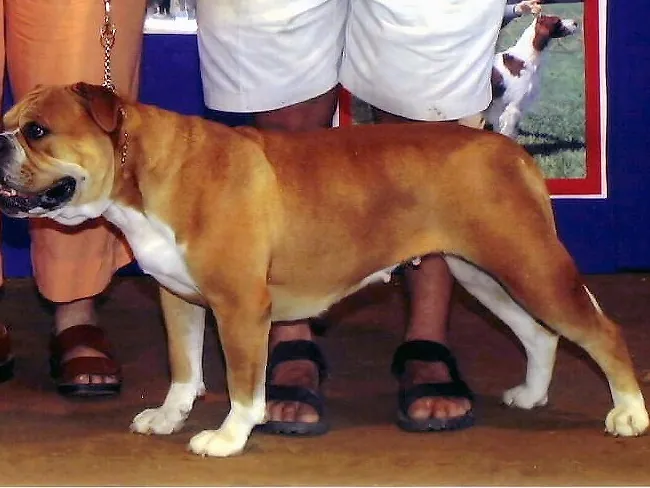
The Bull-Boxer is a muscular, stocky crossbreed whose look depends on how much it takes after each parent. Most have a broad chest, a strong neck, a short, smooth coat and a head that sits between the Boxer's longer muzzle and the English Bulldog's very short face. Adults usually stand about 16 to 20 inches and weigh roughly 51 to 79 lb, but because the Bull-Boxer is a mix, individual dogs can fall outside that range.
Some Bull-Boxers are taller and leaner, with a more Boxer-like head, while others are shorter-legged and heavier, with loose skin, facial wrinkles and an undershot jaw from the Bulldog side. A longer muzzle with open nostrils is the healthier option.
Common colors include fawn, brindle, red and white, often with white markings or a black mask. Males are usually larger and heavier in the head than females. There is no breed standard, so color and size are not regulated.
Temperament and Personality
Bull-Boxers are typically friendly, playful and devoted to their families. Many love children and enjoy rough-and-tumble games, though their strength means play with small kids should be supervised.
They can be stubborn, a trait from both parents, and some have a noticeable prey drive. With early socialization they usually get along with other dogs, but they may chase cats or small animals.
Many Bull-Boxers inherit the Boxer's bouncy, playful energy along with the Bulldog's more relaxed attitude. Individual personalities vary widely because both parent breeds contribute differently in each dog.
Are Bull-Boxers Good for First-Time Owners?
Bull-Boxers can be a reasonable choice for first-time owners who are active and ready for a strong, boisterous young dog. Their friendly, people-oriented nature works in their favor, and many are very forgiving with family members.
The challenges are physical and health-related. A young Bull-Boxer can be mouthy, bouncy and stubborn, so puppy classes, leash training and consistent rules are essential. First-time owners should also understand brachycephalic health issues and choose a puppy with a longer muzzle and open nostrils. Adopting an adult whose size, health and temperament are already known is often the easiest route for beginners.
Can a Bull-Boxer Live in an Apartment?
Yes, many Bull-Boxers adapt to apartment life if they get enough exercise. They are often fairly calm indoors once their needs are met, they are not usually heavy barkers and their short coat keeps grooming simple.
Plan on about an hour of daily activity, split into walks and play, plus mental work like food puzzles. Dogs with shorter, more Bulldog-like faces need gentler exercise and an apartment that stays cool in summer, since they overheat easily. Elevators help, as stairs can be hard on joints. Check building rules first, because some apartments limit dog size or restrict bully-type mixes.
Are Bull-Boxers Good with Cats?
Many Bull-Boxers live peacefully with cats, especially when raised with them from puppyhood. Both parent breeds can be friendly with household cats, though the Boxer side may contribute a stronger urge to chase.
Because Bull-Boxers vary widely, temperament around cats depends on the individual. Some are gentle and curious, while others have a noticeable prey drive and may chase unfamiliar cats outdoors. Introduce a new dog slowly, use baby gates, reward calm behavior and give the cat high escape routes and a dog-free room. Their boisterous play style can be too rough for a timid cat, so supervise early interactions.
Exercise and Training
Most Bull-Boxers need around an hour of daily activity: brisk walks, fetch and play sessions. Those with a shorter, more Bulldog-like face tolerate heat and intense exercise poorly, so adapt activity to the individual and avoid hot weather.
Use short, fun, reward-based sessions. Start leash training early, as an adult can be powerful. Mental work such as food puzzles and nose games helps prevent boredom and chewing.
Puppies can be mouthy and boisterous, so teach bite inhibition and calm greetings early. Crate training helps manage chewing.
Grooming and Shedding
The short coat is easy to maintain with a weekly brush. Shedding is moderate. Clean facial wrinkles regularly and dry them well to prevent skin infections, especially in dogs with Bulldog-type folds.
Bull-Boxers can be prone to skin allergies, so watch for itching, redness or ear problems.
Feeding and Nutrition
Bull-Boxers love food and gain weight easily, and extra weight makes any breathing problem worse. A dog with a shorter, Bulldog-like face should be kept particularly lean, with an easily felt rib cage and a visible waist. Measure meals rather than free-feeding.
Puppies do well on three meals a day until about six months, then two meals. Because adult size varies so much in this mix, choose a complete puppy food suited to the expected adult weight and ask your vet to track growth.
Short-muzzled dogs can swallow air while eating, which leads to gas and sometimes regurgitation. A slow-feeder bowl or a shallow, wide bowl helps. Avoid hard exercise right after meals.
Skin allergies are common in both parent breeds. Persistent itching, paw licking or ear infections may have food or environmental causes, and a vet-guided elimination trial is the reliable way to identify a food allergy. Clean and dry facial folds after meals. Keep training treats small and counted in the daily ration.
| Adult weight | Less active | Typical adult | Very active |
|---|---|---|---|
| 51 lb | 1,030 kcal | 1,180 kcal | 1,480 kcal |
| 79 lb | 1,440 kcal | 1,640 kcal | 2,050 kcal |
Estimates use the resting energy formula veterinarians work with (70 × body weight in kg0.75) and standard activity factors. Use the feeding guide on your food as a starting point and adjust to body condition. Puppies, seniors, pregnant animals and pets that need to lose weight have different needs, so ask your vet.
Health and Lifespan
Health depends heavily on how much Bulldog structure a dog inherits. A short muzzle and narrow airways can cause brachycephalic obstructive airway syndrome, with noisy breathing, heat intolerance and exercise limits. Problems also reported in the parent breeds include hip dysplasia, heart disease, eye conditions, spinal problems and skin allergies.
Look for breeders who health test both parents (hips, heart, eyes) and avoid extreme flat faces, or consider adopting an adult whose health is known. Lifespan ranges widely, roughly 10 to 15 years.
Bull-Boxer Price and Cost of Ownership
As a crossbreed without a breed club or standard, the Bull-Boxer has no reliable published price range. Prices vary widely by breeder, region and parent dogs, and some sellers charge high prices for mixes with little health testing. Ask for hip, heart and eye results for both parents, and avoid puppies with very flat faces or pinched nostrils. Boxer and bulldog mixes regularly appear in shelters and rescues, so adoption is a realistic option.
Ongoing costs depend largely on how much Bulldog structure a dog inherits. Shorter-muzzled dogs may need treatment for breathing problems, sometimes including airway surgery, as well as care for skin fold infections and allergies.
Insurance is worth considering early, since enrollment before problems appear avoids exclusions. Some insurers, landlords and municipalities place restrictions on bully-type mixes.
Is the Bull-Boxer Right for You?
A Bull-Boxer can be a great family dog for active households that want an affectionate, playful companion and can commit to training and health care. It does best with a yard or regular outdoor time and owners who are home a fair amount.
It may not suit very hot climates, owners wanting a predictable size and look, or people unprepared for potential vet costs.
Bull-Boxer Traits at a Glance
Bull-Boxer FAQ
How big do Bull-Boxers get?
Most stand about 16 to 20 inches at the shoulder and weigh around 51 to 79 lb, but mixes vary.
Are Bull-Boxers good family dogs?
Usually yes. They are affectionate and playful, and many are very good with children, though their strength calls for supervision.
Do Bull-Boxers shed?
They shed moderately. Their short coat is easy to care for.
Do Bull-Boxers have breathing problems?
Dogs with a shorter Bulldog-type muzzle can have breathing problems and heat intolerance. Choose a puppy with a longer muzzle and open nostrils.
How long do Bull-Boxers live?
Typically about 10 to 15 years, depending largely on health.
Are Bull-Boxers easy to train?
They are intelligent but can be stubborn. Short, fun, reward-based sessions work best.